Työhuoneella / in the studio
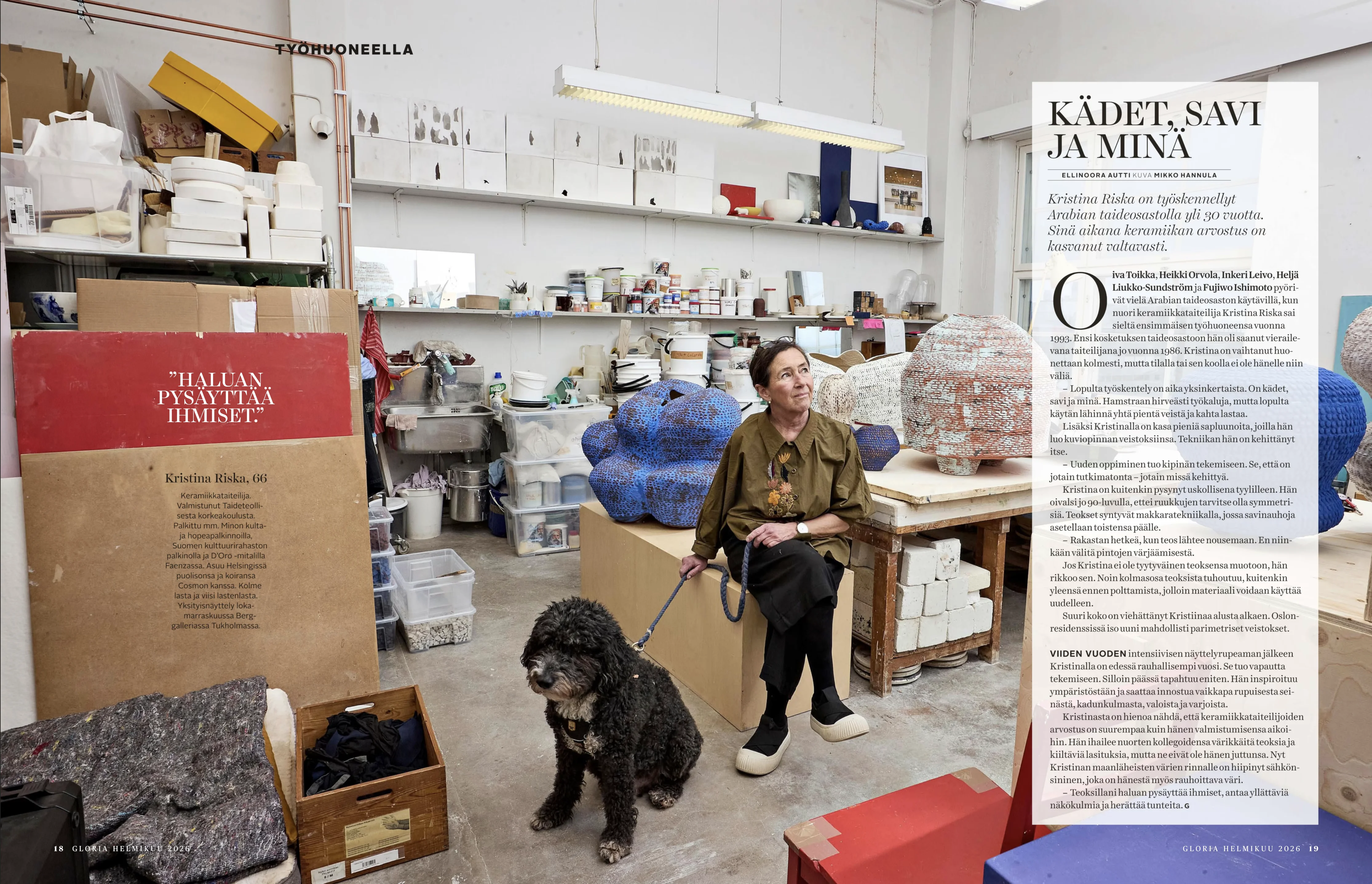
Hands, Clay and I
*
Transcription of the Article
Listen to the AI podcastA conversation about Kristina Riska's three decades in ceramics — the coil technique, asymmetry, kiln scale, earthy tones with a hint of electric blue, and the shift of ceramics from craft to fine art.
⚦ Today, we're diving into the work and career of Kristina Riska, a Finnish ceramic artist whose practice spans over three decades at Arabia's art department in Helsinki. She's a fascinating figure in contemporary ceramics, and we'll explore her techniques, philosophy, and the evolving status of ceramic art through her story. ♀ Yeah, Kristina's career really offers a rich lens on how ceramics have shifted from craft to fine art. She graduated from the University of Art and Design Helsinki, which is a major institution for applied arts and has been recognised with some pretty prestigious awards. Gold and silver medals from Mino, the Finnish Cultural Foundation's prize, and the Doro medal from Faenza in Italy. That last one is especially notable in the ceramics world. ⚦ Absolutely. And she's been based in Helsinki with her family, her spouse, their dog Cosmo, plus three children and grandchildren. It's interesting how her personal life and environment seem to feed into her work, especially now that she's entering a quieter phase after an intense five-year exhibition period. ♀ Right, and that quieter phase seems to be a creative liberation for her. She's drawing inspiration from everyday surroundings, weathered walls, street corners, light, and shadow. It's a reminder that even in a highly technical field like ceramics, the mundane can spark profound artistic exploration. ⚦ Speaking of technical, Kristina's primary method is the coil technique, or "makkara" (= sausage), as it's called in Finnish. She builds forms by stacking long rolls of clay, which allows her to break away from traditional symmetry. She embraced asymmetry in the 1990s, which was quite a shift from conventional pottery. ♀ Yeah, that's a key point. The coil technique inherently supports organic, irregular shapes, which fits perfectly with her philosophy. And despite collecting a lot of tools, she mainly uses just a small knife and two scrapers, plus some small stencils for patterned surfaces. It's a very pared-down toolkit, emphasising the hands-on, tactile nature of her work.
⚦ That minimalism in tools contrasts with the complexity of her forms. And I find it fascinating that about a third of her pieces get destroyed before firing if she's not satisfied with their shape. That kind of rigorous self-critique is intense, but it also shows how destruction is part of her creative process. The clay gets recycled, so it's not wasteful, but it's a reminder that creation often involves letting go. ♀ Exactly. That willingness to destroy imperfect work before firing is a powerful insight into her dedication to form and quality. It's not just about making something. It's about making something that truly resonates with her vision. ⚦ Another technical aspect worth noting is the role of kiln size. During her residency in Oslo, she had access to a large kiln that allowed her to create sculptures over two meters tall. Kiln capacity is often an overlooked constraint in ceramic sculpture, but it directly influences the scale and ambition of the work. ♀ That's a great point. The kiln is both a technical limitation and an enabler. Having a large kiln opens up possibilities for monumental pieces, which Kristina has clearly embraced. It ties back to her love of large-scale work from early on. ⚦ On the color front, she mostly sticks to earthy, grounded tones, which reflect a connection to natural materials and landscapes. But recently, she's introduced electric blue, a color she finds calming. It's a subtle but meaningful shift, especially since she admires the vibrant, glossy glazes of younger artists, but chooses to maintain her own, more subdued aesthetic. ♀ That tension between tradition and innovation is really interesting. She respects the innovations of younger ceramicists, but remains true to her personal style. It highlights how ceramic art today balances heritage with experimentation.
⚦ And that balance is part of a broader evolution in how ceramics are valued. When Kristina started, ceramics were often seen as functional craft. Over her career, she's witnessed ceramics gain recognition as fine art with conceptual depth. Her work embodies that shift. ♀ Yeah, and her goal to stop people, provoke unexpected perspectives, and evoke emotions shows ceramics' capacity beyond utility. It's about sensory and conceptual engagement, which is a hallmark of contemporary ceramic art. ⚦ So to sum up, Kristina Riska's career offers a compelling case study in the technical, aesthetic, and cultural evolution of ceramics. From her coil technique and rigorous self-critique, to her nuanced color palette and embrace of asymmetry, she exemplifies a deeply thoughtful and evolving practice. ♀ And her current phase, inspired by everyday environments and freed from the pressure of exhibitions, suggests a continuing journey of exploration. It's a reminder that artistic growth is ongoing, shaped by both internal drive and external context. ⚦ Definitely. Kristina's story enriches our understanding of ceramics as a dynamic, multifaceted art form.
(Thanks for joining us in this deep dive. Thanks. Looking forward to exploring more artists like her in future episodes. Created by Acrobat Generate podcast AI from an article in Gloria Magazine 02/2026)